Learning on the Job: Your First Years in Practice

Image: Mina Rad on Unsplash
It’s not the same as university
When you start your first job in architecture, engineering or related fields, there’s a great deal to learn. That’s obvious. What’s less obvious is how you’re supposed to learn it.
At university, much of the learning is made explicit. There are courses, tutors, projects and reviews. You may not always understand where it is heading, but it will have been thought through for you.
In practice, you learn in a variety of ways: through training, reading, mentoring, conversations and observing other people. But the primary method is doing the work itself.
You’re given a drawing, calculation or report to work on. You attend a meeting, help resolve a coordination problem or carry out a site visit. Each task has a purpose and something you’re expected to contribute. Each can also provide an opportunity to learn.
But often, nobody tells you what you should be learning while you’re doing the work. The task is explicit; the learning within it may be much less obvious.
This post is about recognising and making use of those opportunities while doing ordinary work. I’ll return to the other ways of learning in later posts.
I’ve spent much of my working life assuming that people develop through experience. I still think that’s right. But completing tasks doesn’t necessarily make you more capable. What matters is how you use those experiences to develop your understanding and judgement.
The task beneath the task
Imagine being asked to update a building condition report in the light of new survey information.
The survey indicates that the building elements in question are in poor condition, so you update the conclusions with a recommendation for replacement.
That may be a reasonable recommendation, but a senior colleague asks how you reached it. Does poor condition necessarily mean replacement? Could the elements be repaired, or only the damaged parts replaced? Is further investigation needed?
Each option may have different implications for construction, programme, cost and risk. Understanding those implications, and discussing them with the people affected, helps you arrive at a better-informed recommendation.
You could complete the report update without exploring any of those questions. Or you could use the task to understand how evidence about a building’s condition informs a decision about what should happen next.
The same assignment can offer quite different amounts of learning, depending on what you question and what other people help you understand.
There is a task beneath the task: learning how to interpret evidence, question an initial conclusion, consider alternatives and explain the reasoning behind your recommendation.
Working and getting better at working
Time spent doing something provides opportunities to learn from it. But it doesn’t guarantee that learning will happen. Repetition can build familiarity and make us more efficient, but it can also leave us repeating an approach we’ve never properly understood.
In his TED talk, How to get better at the things you care about, Eduardo Briceño distinguishes between the ‘performance zone’ and the ‘learning zone’. In the performance zone, the immediate aim is to deliver our best work and minimise mistakes. In the learning zone, the aim is to improve: to examine something we’ve not mastered, practise, receive feedback and adjust.
Both matter. But his distinction helps explain why working hard doesn’t necessarily mean we’re getting better.
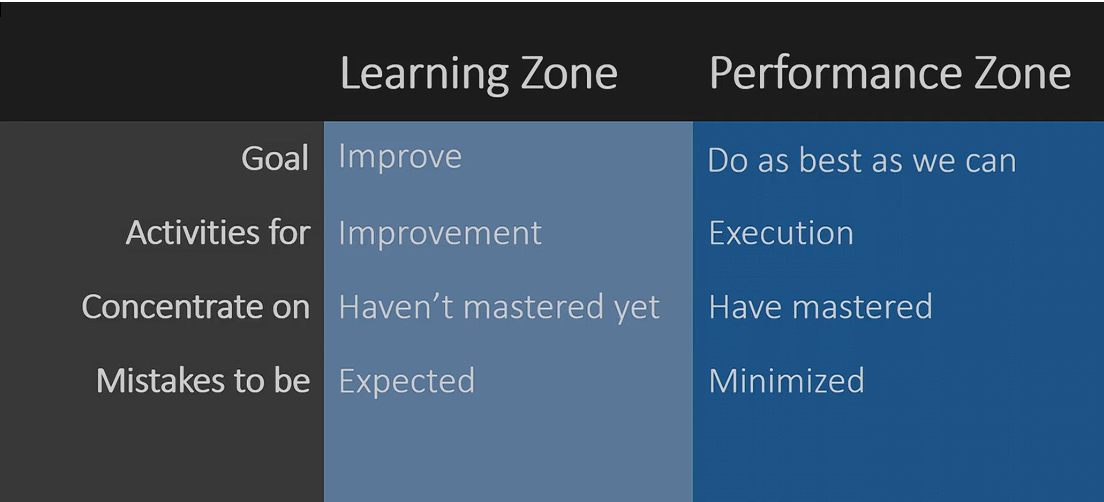
Table from How to get better at the things you care about - Eduardo Briceño
For professional practice, I think the useful question is how to create moments of learning within work that still has to be delivered reliably. A graduate might sketch the behaviour they expect before starting a calculation, then compare the result with that expectation and discuss any differences with the colleague reviewing their work. The project needs a dependable answer; the conversation helps the graduate understand how to reach one.
Learning can be embedded in the work, but we still need to make room for it. That may mean pausing to investigate, discussing an alternative before committing to it, or returning to a decision after we know the consequences.
The following questions offer a way to do that before, during and after an ordinary task.
Before: understand what you are trying to achieve
Before starting a task, it helps to establish its purpose. Who needs the result? What decision will it support? How far does it need to be developed at this stage?
These questions can change how you approach the work. An exploratory sketch is different from a drawing issued for construction. An initial calculation might help compare options; a later one might establish whether a particular solution is adequate.
If the purpose is unclear, asking about it is part of doing the task properly. It also helps you learn how experienced people decide where to spend their time.
Then find the source. Read the brief, look at the relevant drawing, find the clause or examine the manufacturer’s information. A previous example can be useful, but you need to understand which of its circumstances apply to your situation.
Somebody else’s explanation is often a good starting point. Following it back to its source helps you establish why you believe it, and where its limits might be.
Finally, ask what this task might give you an opportunity to learn. You do not need an elaborate learning objective. You might simply want to understand why a particular junction is awkward, or what makes a calculation useful to the person reviewing it.
During: give others something to respond to
As you work, some things will be clear and others will remain uncertain. Learning involves recognising the difference and deciding what to do about it.
When you need help, try to make your current understanding visible. Explain what you’ve checked, what you’re assuming and where you’re stuck. A sketch or marked-up drawing may be more useful than a long explanation.
Sometimes “What should I do?” is the only question you can manage. That’s fine. But “I think this arrangement will work for these reasons, and I’m uncertain about this part” gives a colleague more to respond to. They can examine your reasoning as well as your answer.
Preparing that explanation may also reveal a gap before the conversation begins.
This is not a requirement to struggle alone until you’ve earned the right to ask. If you can’t identify a sensible way forward, ask early. Part of becoming more capable is learning when further investigation will help and when you need another person’s perspective.
Pay attention to what they notice. Why did they look at that junction first? Why did they question that assumption? Why were they comfortable with one approximation but concerned about another?
After: follow the work a little further
Submitting the work is often the point at which your attention moves elsewhere. Yet some of the most useful learning may still lie ahead.
What did your colleague reviewing the work change and why? Was the drawing understood? Did another discipline need something you’d omitted? What happened when somebody tried to build it?
You will not be able to follow every task to its final consequence. Projects are long, responsibilities change and access to site varies. But where you can, follow a piece of work beyond your own contribution. Ask to see the response, join the discussion or look at what was built.
A line on a drawing becomes a material, a tolerance, an operation or a difficulty for somebody else. Seeing that connection gives your next decision more substance.
Reflection can be equally modest. What surprised you? What did you misunderstand? What would you notice earlier next time?
A few notes may help preserve something you would otherwise forget. They need not become a record of everything you did. The useful things to capture are those that changed how you understood the work.
Choose one thing you’ll approach differently next time.
Who is responsible for your learning?
The primary purpose of the business is to deliver work and be paid for it. Learning happens alongside that, in an environment shaped by deadlines, budgets and other people’s availability. Even with supportive colleagues, you can’t assume that the tasks you’re given will provide everything you need to learn.
In that imperfect learning environment, you need to take an active part in your own development. After all, you have the greatest stake in it!
That means asking yourself what you want to become better at, recognising gaps in your capabilities and discussing them with the people who can help. Ask for feedback, seek opportunities to take more responsibility and explain why a particular task, conversation or site visit would be useful. Some needs will be met through your current work; others may require opportunities beyond it.
You should also expect support and say something when you’re not getting it. The people supervising your work can explain their reasoning, help you work through unfamiliar problems and review your decisions. Your line manager can look across your project work and help arrange broader experience. Learning and Development teams and professional institutions can contribute through training, development frameworks, mentoring and access to a wider professional community. Take advantage of all of them.
Taking responsibility does not mean doing it alone. It means being deliberate about what you need and making use of the people and opportunities available.
The task matters. But so does the person you’re becoming while you do it.
Summary
- Look for what the task can teach you
- Make time to investigate, practise and review
- Before the task: Understand the purpose and check the sources
- During the task: Show your reasoning and ask questions
- After the task: Reflect on what you learnt and follow what happens
- Take responsibility for your development and seek support